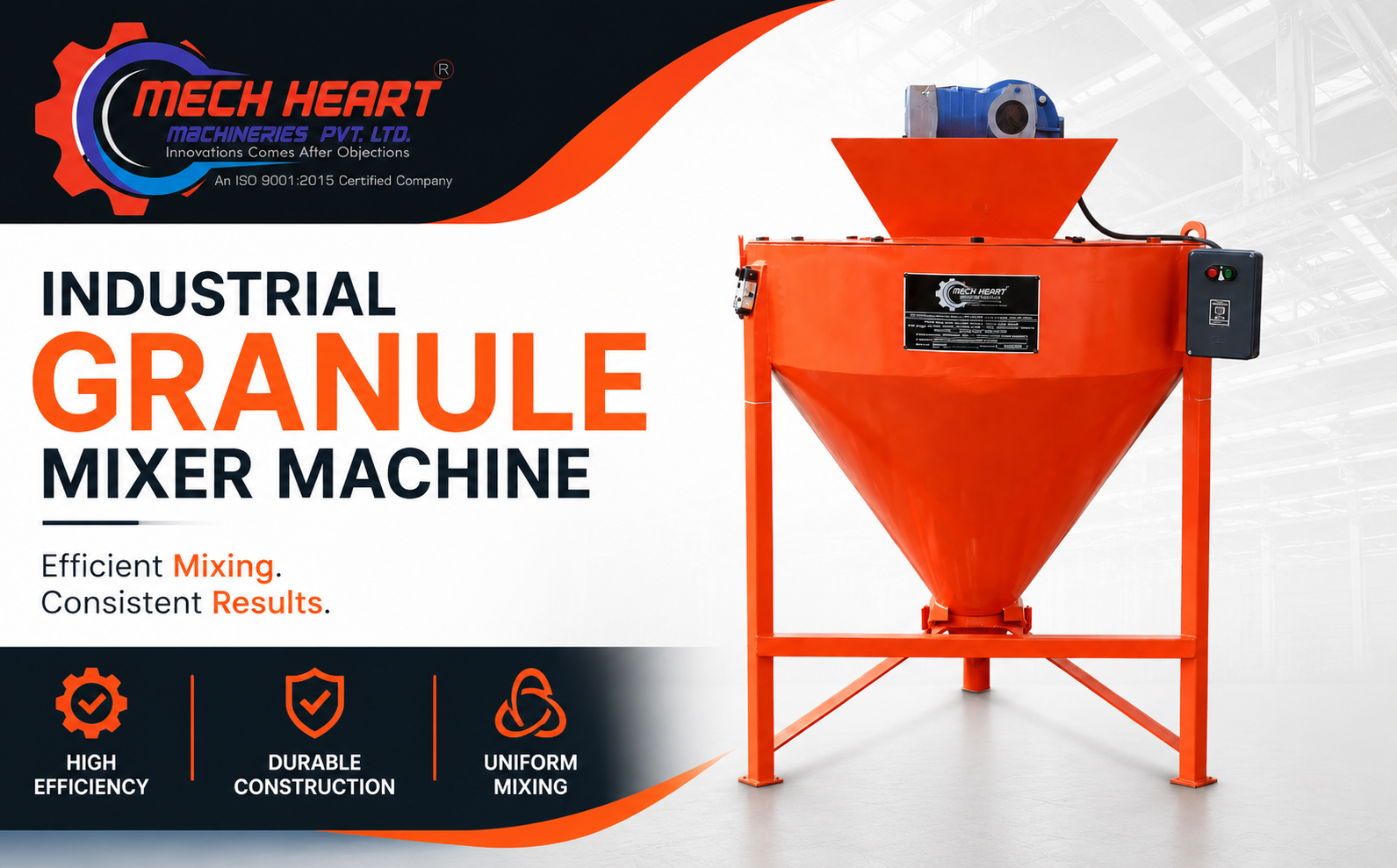
Industrial Granule Mixer Machine
Discover high-performance industrial granule mixer machines in Ahmedabad. Mech Heart offers reliable, efficient solutions for your material processing needs.
Key Features and Technical Specifications
When evaluating an industrial granule mixer machine, several key features contribute to its performance and suitability for specific applications:
- Mixing Mechanism: Options include ribbon blenders, paddle mixers, V-blenders, or conical screw mixers, each suited for different material types and blending requirements.
- Capacity: Available in various sizes, from small laboratory units to large industrial-scale mixers, measured in kilograms or cubic meters per batch.
- Material of Construction: Typically stainless steel (SS 304, SS 316) for durability, corrosion resistance, and ease of cleaning, especially crucial for food and pharmaceutical applications.
- Mixing Time: The duration required to achieve a homogeneous blend, which varies based on the mixer type, batch size, and material properties.
- Power Requirements: Specifies the motor power (HP/kW) and voltage needed to operate the machine efficiently.
- Discharge Mechanism: Features like bottom discharge valves, chutes, or tilting capabilities for easy and complete unloading of the mixed material.
- Safety Features: Includes guards, emergency stops, and interlocks to ensure operator safety during operation.
- Dust Control: Integrated systems or designs that minimize dust generation during the mixing process, important for health and environmental compliance.
Industrial Applications and Use Cases
The versatility of industrial granule mixer machines makes them indispensable across numerous sectors:
- Plastics Industry: Blending virgin polymers with masterbatches, additives, fillers, and colorants to create specific plastic compounds for molding or extrusion.
- Chemical Industry: Homogenizing powders, granules, and crystalline solids for producing fertilizers, detergents, pigments, and other chemical formulations.
- Pharmaceutical Industry: Precisely mixing active pharmaceutical ingredients (APIs) with excipients to ensure uniform drug dosage in tablets or capsules.
- Food Processing: Blending dry food ingredients like flour, sugar, spices, cereals, and powdered mixes for baked goods, snacks, and ready-to-eat meals.
- Agrochemicals: Mixing granular pesticides, herbicides, and fertilizers to ensure even distribution of active components.
- Construction Materials: Blending cementitious powders, aggregates, and additives for specialized construction products.
- Detergent Manufacturing: Combining various powdered ingredients to create uniform detergent formulations.
- Animal Feed Production: Mixing grains, proteins, vitamins, and minerals to create balanced animal feed formulations.
How to Choose the Right Industrial Granule Mixer Machine
Selecting the appropriate industrial granule mixer machine requires careful consideration of your specific operational needs. Here’s a checklist to guide your decision:
- Material Characteristics: Assess the size, density, flowability, abrasiveness, and potential for dust or clumping of the materials you will be mixing.
- Batch Size and Throughput: Determine the volume of material you need to mix per batch and your required production rate to select an appropriately sized machine.
- Mixing Uniformity Requirements: Understand the level of homogeneity needed for your application; some processes demand near-perfect uniformity, while others are less critical.
- Material Compatibility: Ensure the mixer's construction material is compatible with your raw materials to prevent contamination or corrosion.
- Ease of Operation and Cleaning: Consider how simple the machine is to load, operate, unload, and clean, especially important for multi-product facilities or stringent hygiene requirements.
- Energy Efficiency: Evaluate the power consumption of the mixer relative to its capacity and mixing efficiency.
- Supplier Reputation and Support: Research the manufacturer's experience, customer reviews, and the availability of after-sales service, spare parts, and technical assistance.
- Customization Needs: Identify if your process requires specific features, modifications, or integration with other equipment.
Quality Standards and Compliance
For any industrial machinery, adherence to quality standards and compliance with relevant regulations is non-negotiable. Manufacturers like Mech Heart Machineries Pvt. Ltd. prioritize building machines that meet industry benchmarks. This often involves using high-grade materials, employing robust manufacturing processes, and ensuring that the equipment is designed for safe and efficient operation. Buyers should verify that the machinery is constructed from appropriate materials, especially stainless steel grades like SS 304 or SS 316 for applications requiring high hygiene or corrosion resistance. Compliance with safety norms and ensuring the machine’s design minimizes operational hazards are also critical factors that demonstrate a commitment to quality and reliability.
Why Mech Heart's Experience and Capability Matter
Established in 2020 in Vatva, Ahmedabad, Mech Heart Machineries Pvt. Ltd. brings a focused approach to manufacturing industrial equipment. With over 8 years of prior experience in the woven sack packaging and FIBC industries, the company understands the intricacies of material handling and processing. This background informs their design and manufacturing of robust machinery like the industrial granule mixer machine. Mech Heart’s capability lies in its commitment to delivering reliable solutions through efficient processes and skilled expertise. Their manufacturing adheres to quality control measures, ensuring that each machine is built for durable performance and customer satisfaction.
Installation, Maintenance, and Care Tips
Proper installation and regular maintenance are crucial for the longevity and optimal performance of your industrial granule mixer machine.
- Installation: Ensure the machine is installed on a stable, level surface. Connect it to a power source that matches its specifications and ensure all safety guards are in place before operation.
- Pre-Operation Checks: Before each use, inspect the mixing chamber for any foreign objects, check that the discharge mechanism is clear, and verify all electrical connections are secure.
- Loading Materials: Load materials gradually and in the correct sequence as recommended by the manufacturer to avoid overloading the motor or causing uneven mixing.
- Operation: Monitor the mixing process to ensure it runs smoothly. Avoid operating the machine for longer than necessary to achieve the desired blend, as this can lead to excessive wear or material degradation.
- Cleaning: Thoroughly clean the mixing chamber and discharge components after each batch, especially when switching between different materials or colors, to prevent cross-contamination. Use appropriate cleaning agents compatible with the machine's material of construction.
- Lubrication: Follow the manufacturer's schedule for lubricating moving parts, such as bearings and gearboxes, to ensure smooth operation and prevent premature wear.
- Regular Inspections: Periodically inspect the machine for any signs of wear, loose fasteners, or damage to the mixing elements or motor. Address any issues promptly.
Frequently Asked Questions
An industrial granule mixer machine is designed for dry granular materials. This includes a wide range of substances such as plastic granules, powders, chemical compounds, food ingredients like flour and sugar, pharmaceutical powders, and agricultural granules. The specific type of mixer will determine its suitability for different particle sizes and densities.
The correct batch size depends on your production volume and the mixer's capacity. You should consider the amount of material you need to process per hour or per shift. It's advisable to operate the mixer within its recommended capacity range to ensure efficient blending and prevent strain on the motor and components.
Mixing time varies significantly based on the mixer design, the materials being blended, and the required homogeneity. Simple blends might take a few minutes, while more complex formulations requiring very high uniformity could take longer. Manufacturers provide guidelines, but actual times may need to be determined through testing.
The material of construction is critical, especially for industries like food, pharmaceuticals, and chemicals. Stainless steel (SS 304 or SS 316) is commonly used for its durability, corrosion resistance, and ease of cleaning, preventing contamination. Using the wrong material can lead to product spoilage or safety issues.
Regular maintenance includes cleaning the mixing chamber after each use, lubricating moving parts according to the manufacturer's schedule, inspecting for wear and tear on blades or paddles, and checking electrical connections. Periodic professional servicing may also be recommended.
Yes, many manufacturers offer customization options. This can include modifications to the mixing mechanism, specific discharge configurations, integration of heating or cooling jackets, dust collection systems, or specialized controls to meet unique process requirements.
Conclusion
For manufacturers in Ahmedabad seeking to enhance their production efficiency and product consistency, investing in a high-quality industrial granule mixer machine is a strategic decision. The right equipment ensures that raw materials are blended uniformly, leading to superior final products and optimized operational workflows. Mech Heart Machineries Pvt. Ltd. offers reliable solutions, leveraging their manufacturing expertise to provide machines that meet the rigorous demands of various industrial applications. By carefully considering material characteristics, capacity needs, and the manufacturer's capabilities, businesses can select a granule mixer that serves as a dependable cornerstone of their production process.
Get In Touch
Mech Heart Machines Pvt. Ltd.